
Working as a product designer in a software development company is associated with many different challenges. The first one is to be versatile – after all, a product designer is not only the user’s advocate (just like UX designer), but also helps to achieve the client’s goals. Creativity and analytical thinking are needed, as well as the ability to cooperate with many stakeholders at once – clients, project managers, analysts, testers and developers. Their work not only leads to the creation of an interface that pleases the eye but, above all, to the success of the entire product. This includes conceptual work, strategy and implementation, which is focused on delivering real business value, not just positive UX.
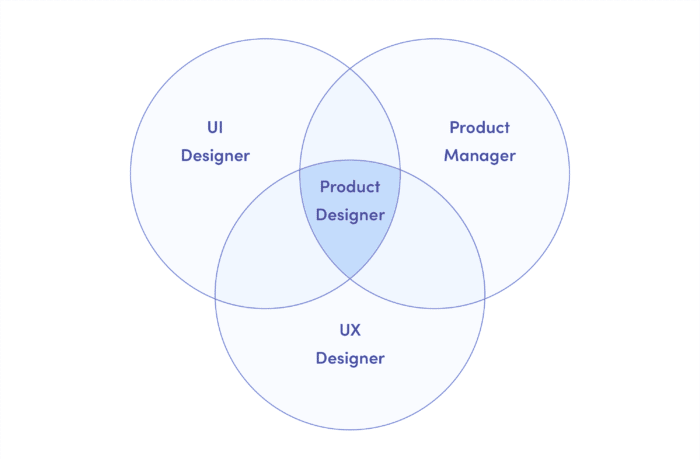
Therefore, whether you want to create a website, game or application, an efficient and properly executed product design process is key to the project’s success. Systematic and iterative work methodology allows the team to deliver products that are of the highest quality, have business potential, and are tailored to the needs of potential users. Product design process is a useful tool for creating innovative and attractive business solutions, which helps to meet the growing expectations of customers and contributes to the success of enterprises.
But what exactly is the process of creating a product from A to Z?
The product design process is based on the popular Design Thinking methodology. According to its creator, Tim Brown, it is a human-centred approach to innovation that integrates the needs of people, the capabilities of technology, and the business requirements needed to achieve success. Interestingly, this methodology is used not only when designing and creating digital products, but also in various physical services and products. One effective tool that allows users to describe Design Thinking as alternating cycles of divergent (expanding, exploratory) and convergent (narrowing, analytical) thinking is Double Diamond.
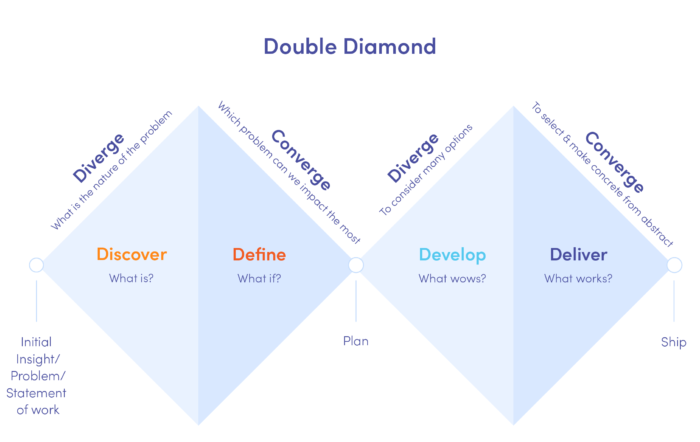
Double Diamond is a great tool that illustrates the design process, but you may feel that some steps are missing from it. Depending on how the individual sections of a Double Diamond are interpreted, the end result can be either a prototype or a ready-to-market product – two completely different things. For this reason, at our product design company, we use the Triple Diamond scheme, which additionally includes the aspect of cooperation with development teams, without which it is difficult to imagine a product design process. It consists of several phases that structure the work on the project.
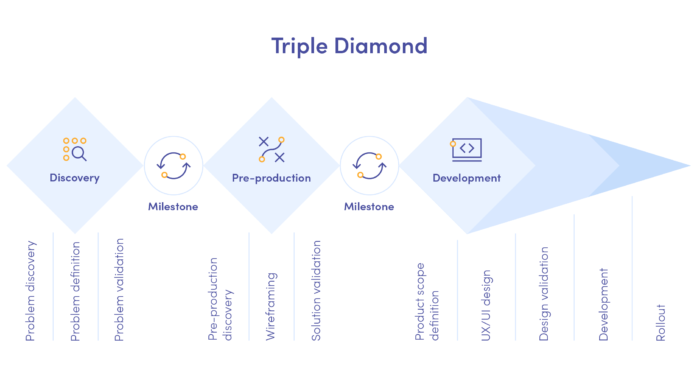
Triple Diamond is a flexible method, which means that it is tough to clearly define the exact framework of action based on this concept. The scope of work performed during the process depends on two major factors: the complexity of the identified problem and the work already done on the client’s side. But what does this really mean?
Imagine two different scenarios. The first, when the client has nothing but a general idea, and the second, when the client wants to plan new features or conduct the next development phase. This flexibility is an inherent part of the Triple Diamond method! In addition, Design Thinking is characterised by an interactive approach and non-linearity. Instead of going through each stage of the process, some of the phases may be repeated many times until satisfactory results are obtained.
